THE RENEWABLE ENERGY GRID
BUILT FOR THE NEXT CENTURY
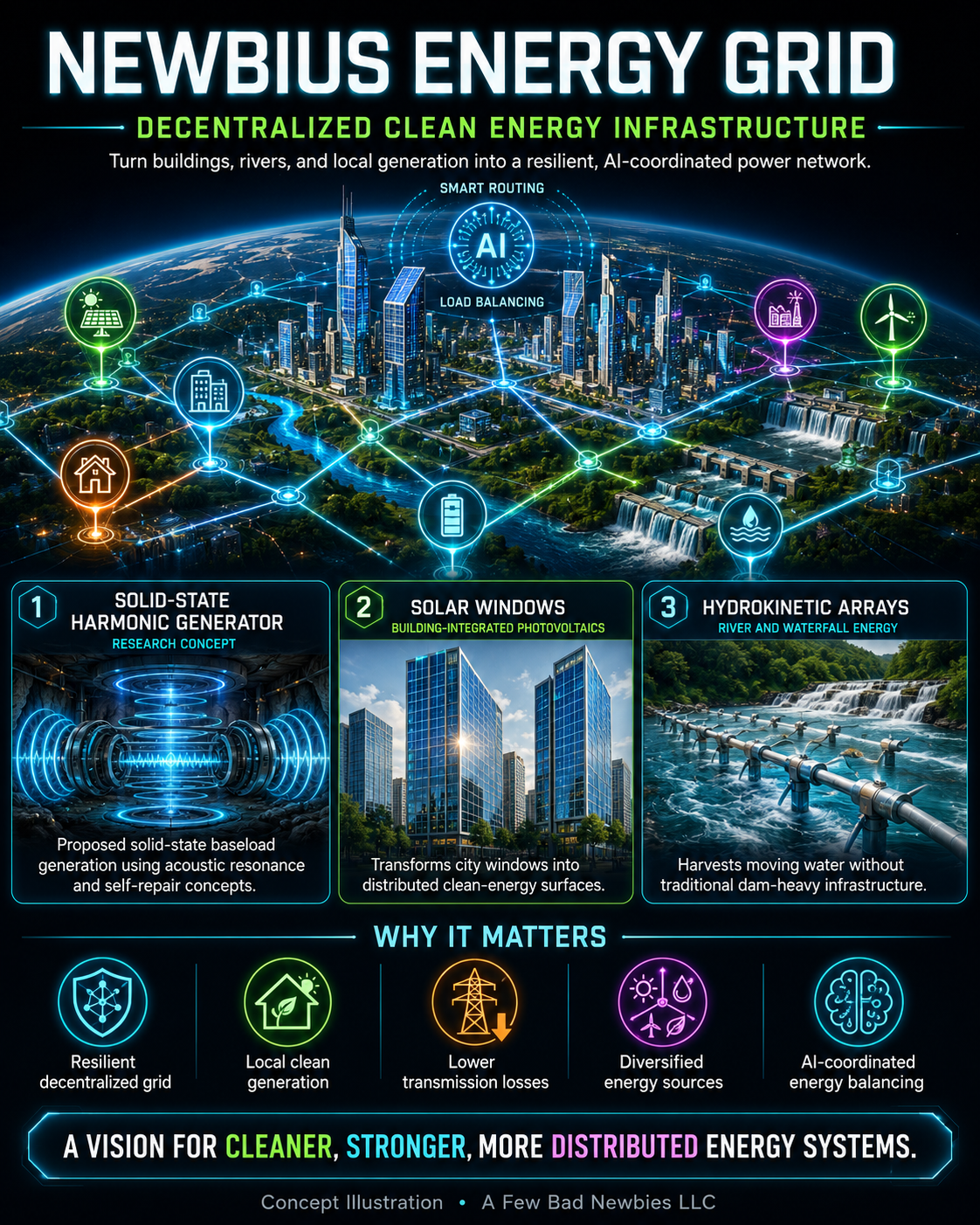
What is NEG? A configurable planning framework for distributed solar generation, in-stream hydrokinetic generation, energy recovery, local storage, islanding controls, and transparent infrastructure financing.
Why it matters: Distributed generation can reduce transmission dependence and improve resilience when it is paired with protection systems, verified controls, maintenance, storage, and site-specific engineering.
What this page does: It calculates internally consistent scenario outputs from explicit inputs. It does not claim measured hardware performance, certified engineering, guaranteed economics, or enacted public policy.
● Commercially established technologies ● Experimental research concepts ● Long-term infrastructure scenarios — clearly separated throughout the platform —
Why The NEG Framework? All figures are calculated scenario outputs from the NEG Enterprise Planning Calculator.
Distributed Resilience
Local generation and islanding controls can limit cascading failures, but protection coordination, storage, cybersecurity, and maintenance remain essential.
Low-Carbon Generation
Building-integrated photovoltaics and site-screened hydrokinetic turbines can generate electricity without combustion at the point of use. Lifecycle impacts still require assessment.
Transparent Planning
Every output is tied to visible quantities, unit costs, efficiency factors, and funding assumptions so a user can inspect the arithmetic instead of relying on unexplained claims.
All outputs are calculations from explicit scenario inputs. They are not measured field performance, engineering certification, a vendor quotation, financial advice, tax advice, or enacted policy.
SOLID-STATE HARMONIC RECOVERY GENERATOR CALCULATED ENERGY RECOVERY
Externally Driven Piezoelectric Conversion • Energy Conservation Enforced • Not a Primary Energy Source
PILOT SETUP
Published ReferenceEnter location and project parameters. All outputs are calculated from these explicit inputs using standard energy equations.
Hydro Site Inputs (optional — enable to add hydro generation)
SOLID-STATE HARMONIC RECOVERY GENERATOR EXPERIMENTAL RESEARCH
Externally Driven Piezoelectric Conversion • Energy Conservation Enforced • Not a Primary Energy Source
■ Research-stage concept. Energy conservation enforced: recovered output ≤ drive input. Not a primary energy source. Requires experimental validation.
Uncertainty: ±25–40% for efficiency, ±10% for availability, ±30% for annual recovery estimates.
GLOBAL DEPLOYMENT MODEL LONG-TERM SCENARIO
Scale the planning quantities worldwide. Deployment feasibility remains subject to site conditions, manufacturing capacity, environmental review, permitting, finance, workforce, and grid interconnection.